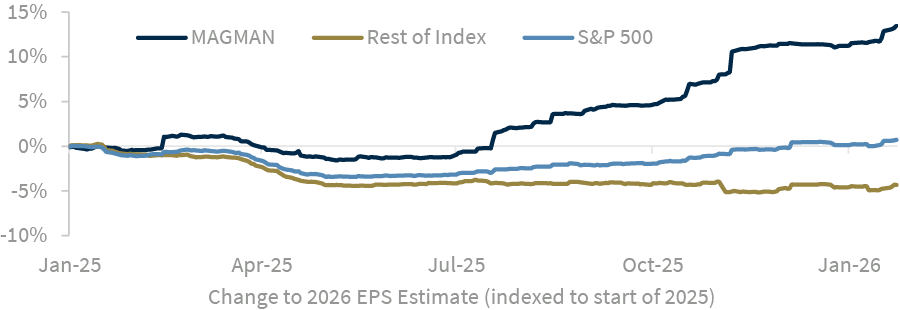
4Q25 earnings season is off to a strong start. So far, over 70% of the S&P 500’s market cap has reported results, and earnings are on track to rise ~13% YoY—up from just 7% at the start of earnings season. This marks the fifth consecutive quarter of double-digit EPS growth, a streak last seen in 2018. To date, roughly 80% of companies are beating estimates—above the 5-year average—and in aggregate are surpassing forecasts by ~8%—the strongest since 1Q21. Yet, despite strong 4Q25 results, the most notable storylines this earnings season have revolved around rotation dynamics and the recent sell-off in tech stocks.
Highlights:
- Labor demand weakened, with Job Openings (JOLTS) falling to a ~5 year low of 6.5 million in December.
- Volatility ramped up, with the S&P 500 declining by 1.9% MTD, driven by fears of AI impacts on the software industry.
- Equity market weakness and softer labor market data drove Treasury yields lower across the curve.
- Weather-related impacts have led to significant volatility in natural gas prices (Henry Hub) in recent weeks.
Volatility has returned to the equity market with the S&P 500 declining1.9% MTD during the first week of February. Market fears surrounding the longer-term AI impact on the software industry have negatively impacted the broader Technology sector. Interestingly, as we note in our charts of the week, it was around this time during the dot-com era that the NASDAQ took a brief leg lower before resuming its multi-year trend higher. Despite recent volatility, capex guidance from the hyperscalers (now expected to surpass $640b in 2026) and continued investment within AI-related products support our positive stance on Technology in the year ahead.
Equity market weakness combined with a trio of soft labor market indicators—rising jobless claims, elevated Challenger layoffs, and weaker JOLTS job openings—drove Treasury yields lower across the curve this week. The weaker jobs data prompted markets to pull forward expectations for the Fed’s next rate cut to June, with a second cut now priced in by October. This repricing triggered a sharp decline in the 2-year Treasury yield, which fell 10 bps to 3.48%, marking itssteepest one-day drop since last October. While the 10-year Treasury yield also slipped to 4.21%, the spread between the 10- and 2-year yields widened to 73bps—near its largest gap in four years.
The ISM Manufacturing PMI surged to 52.6 in January, well above expectations and back into expansion for the first time in a year. Strength was driven by sharp gains in new orders and production, while employment improved but stayed in contraction. Meanwhile, The Services PMI was unchanged at 53.8, marking the 19th straight month of expansion. New orders and employment softened, while inventories and imports fell into contraction. Both surveys highlighted price pressures and tariff-related uncertainty as headwinds.
On the labor front, demand for labor remained weak. The ADP report saw a less than expected 22k jobs added in January, driven by weakness in professional services, while Job Openings (JOLTS) fell to a ~5 year low in December of 6.5 million. In addition, the Challenger report saw layoff announcements in January surging to 108k—the highest print for the month of January since 2009.
Washington’s focus returned to fiscal policy after President Trump signed a $1.2t bill to fund most agencies through September, ending a brief shutdown. DHS funding, however, was extended only two weeks, pushing immigration enforcement debates to a February 13 deadline. With Democrats demanding tighter guardrails and GOP leadership skeptical of a near-term deal, another short-term extension—or even a year-long continuing resolution—appears most likely. The administration is accelerating its push to secure critical mineral supply chains, including Project Vault—a proposed $12b Strategic Critical Minerals Reserve modeled on the Strategic Petroleum Reserve. It is also advancing multilateral pricing frameworks, such as price floors discussed at the inaugural Critical Minerals Ministerial. While company-specific supports remain uncertain, delayed Section 232 tariffs point toward a preference for coordinated, multilateral price stabilization mechanisms.
Polling suggests that Japan’s 'snap' election this Sunday will return to power Prime Minister Takaichi, though the scale of her coalition’s majority remains to be seen. In anticipation of Takaichi's proposed tax cuts—and thus even more borrowing—the Nikkei 225 set a new all-time high this week, while Japan’s 10-year bond yield is hovering near its highest levels since 1999. By contrast, the yen is just above its 52-week lows, after briefly bouncing in late January amid suspected intervention by the US and Japanese governments.
As intense as the swings in gold and silver have been in recent weeks, they pale in comparison to the volatility in the US natural gas market. Prices approached a 52-week low in mid-January, proceeded to nearly double amid an epic snowstorm, but then gave back most of those gains. The gas market is becoming more weather-sensitive over time, because electric generation drives the vast majority of the growth in gas consumption. As a proportion of total gas demand, power plants rose from 31% in 2010 to ~40% in 2025. Compared to many other uses of gas—e.g., as a feedstock for chemicals and fertilizer—electric generation has a much closer linkage to weather.
|






&iconStyle=squared "instagram")